
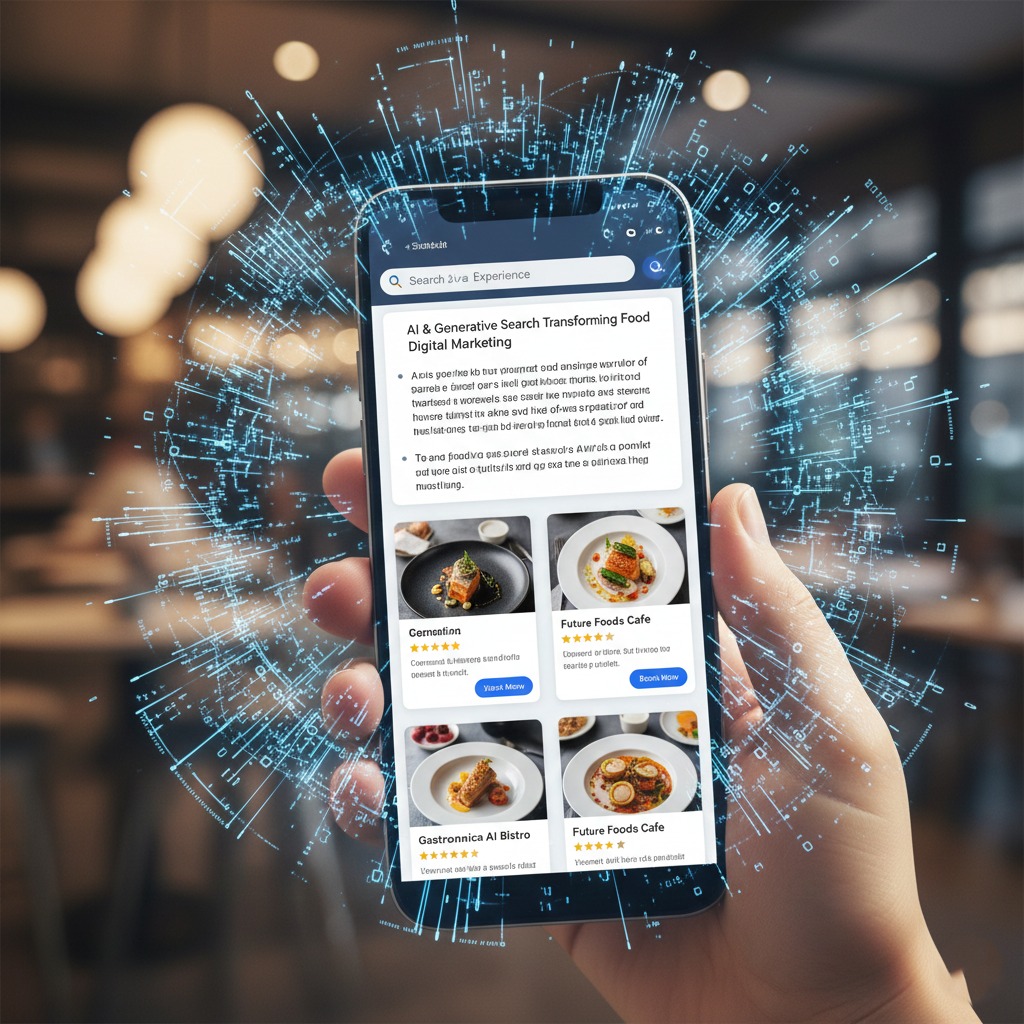
What is Generative Search in Food Digital Marketing?
Generative search is a search experience enabled by AI, driven by platforms such as ChatGPT, Google Gemini, Bing Copilot, and other AI assistants. This emerging form of search gives users direct, conversational, and tailored answers instead of the traditional list of links from the search engine.
Indeed, this shift is a game-changer for food businesses.
AI-driven platforms would suggest your restaurant, café, or food brand directly in the generated response to search queries like “Cafe Marketing in Indore”, “Indore restaurants offering healthy food”, or “fine dining reputation management”.
What It Means for Food Businesses
- AI recommendations can show your café or restaurant to customers.
- Menus, offers, customer reviews, and brand mentions can appear inside AI answers.
- Optimizing for GEO has now become as important as traditional SEO.
- Brand visibility is no longer confined to only Google SERPs.
In other words, if your food business is not optimized for generative search, you could be missing out on high-intent customers.
How Generative AI Is Changing Food Digital Marketing
Generative AI revolutionizes the way food brands connect, engage, and convert their audience. From creating content to analyzing customer behavior, AI makes digital marketing smarter, quicker, and more scalable.
Contrasting with traditional ways of marketing, AI-driven approaches now enable food businesses to respond in real time to the changing consumer preferences.
Advantages of Generative AI in Food Digital Marketing
- Personalization at Scale
AI examines customer behavior, order history, and preferences in order to make personalized offers, emails, and promotions, thus increasing customer satisfaction and repeat visits.
- Faster and Smarter Content Creation
AI can help food businesses create more blogs, menu descriptions, ad copies, social media posts, and promotional content faster while maintaining brand tone.
- Deep Customer Insights
AI processes customer reviews, feedback, and ordering patterns to predict food trends, popular dishes, and seasonal demand.
- Better local SEO performance
AI strengthens visibility for “near me” searches, helping restaurants and cafés rank higher in local discovery results across search engines and AI platforms.
How Generative AI Bolsters ROI and Marketing Performance
Every food business wants to optimize ROI from digital marketing. Generative AI helps improve performance across multiple marketing channels, ensuring better outcomes with lower wastage.
Key Performance Improvements
Improved Ad Targeting:
With AI-driven PPC and paid campaigns, your ads reach users that are most likely to convert.
Higher engagement rates:
Personalized recommendations and AI-driven content improve customer engagement.
Better Conversion Rates:
AI-powered chatbots enable smooth table reservations, food orders, and customer support.
Smarter Analytics & Reporting:
AI tracks campaign performance, identifying what’s working to quickly optimize. At Namastetu Food, a trusted Content Marketing Agency for Food in Indore, we combine AI-powered strategies with advanced SEO services for measurable improvements in traffic, leads, and sales.
GEO vs SEO: Similarities and Differences
Both SEO and GEO are essential to modern Food Digital Marketing – but they serve different purposes.
Search Engine Optimization (SEO)
- Focuses on the ranking of Web sites on Google and other traditional search engines.
- Optimizes keywords, backlinks, technical SEO, and on-page content.
- Objective: To appear higher in search engine results pages.
GEO: Generative Engine Optimization
- Focuses on visibility within AI-driven search engines.
- Optimizes content so AI platforms recommend your food business.
- Objective: Be featured in AI-powered answers and recommendations.
Similarities
- Keyword optimization is key.
- High-quality, updated content is needed.
- Authority, trust and brand signals matter
Key Difference
- SEO ranks links.
- GEO answers questions
Understanding the True Power of GEO
With GEO, it’s not just about adjusting content for algorithms; it’s about becoming the most reliable answer when AI engines search for trusted information.
By GEO, when AI-powered platforms do Web analysis for recommendations:
- Your expertise stands out.
- Your brand is mentioned as an authority.
- Your business is visible across multiple AI interfaces.
Consider GEO as the next step in SEO, tailor-made for the generative AI era. It helps your content to effectively communicate both with humans and machines – keeping your brand visible on all platforms and devices.
AI and the Future of Food Digital Marketing
Undoubtedly, the future of food marketing is AI-driven. AI will influence discovery to decision-making on where customers will eat and what they will order.
Key AI Trends Shaping the Future
- Voice-based food search
“Find me a vegan café near me” or “best pizza place open now”
- AI-fueled menu optimization.
Highlighting popular dishes depending on real-time demand.
- Smarter food delivery promotions
AI-powered offers based on customer behavior
- Advanced SEO & GEO integration
AI tools aligned with SEO for precision targeting
Food businesses adopting AI early will have higher visibility, stronger branding, and long-term customer loyalty.
Frequently Asked Questions (FAQs)
Q1. What is Generative Engine Optimization?
GEO stands for optimizing your food business so that AI platforms such as ChatGPT and Google Gemini recommend your brand in answers they generate.
Q2. How does GEO differ from SEO?
SEO focuses on the ranking of your website on Google. GEO is about ensuring that your business shows up in AI responses. Both are keys to future growth.
Q3. Why is AI important for food digital marketing?
AI enables personalization, predictive analytics, automation, and smarter decision-making—all of which lead to better engagement and increased ROI.
Conclusion
AI and generative search are not the future but a present reality in digital marketing. To remain competitive, restaurants, cafés, cloud kitchens, and hotels will need to integrate SEO with AI-driven geolocation strategies.
By adopting generative optimization, AI tooling, and data-driven marketing, food businesses can:
- Improve visibility online
- Attract high-intent customers.
- Enhance conversions and loyalty. Create sustainable, long-term growth.