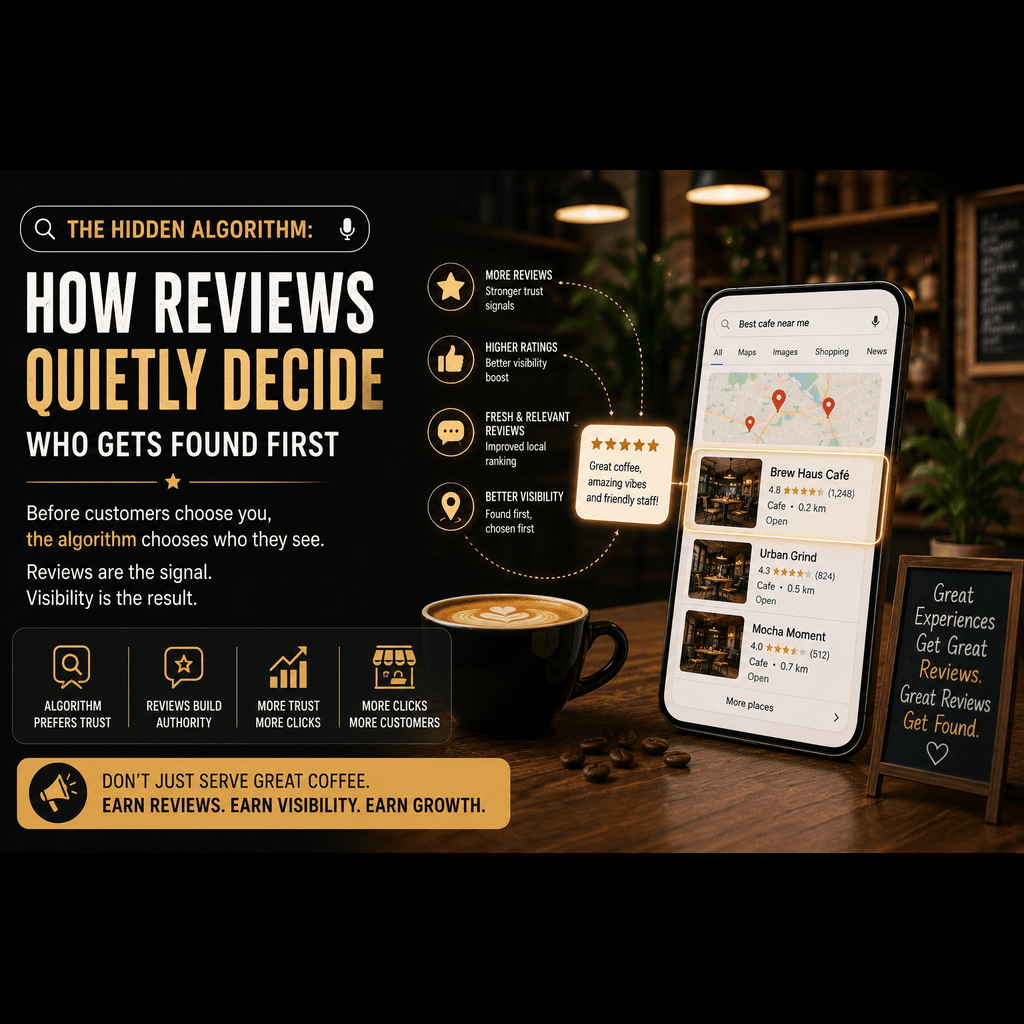
Two restaurants serve nearly identical food, sit a few streets apart, and charge similar prices. One shows up in the first three results when someone searches for “best biryani near me.” The other doesn’t appear until page two. The difference usually isn’t the food, the price, or even the location — it’s the reviews, and more specifically, how those reviews are being read, weighted, and acted on by algorithms most owners never think about. According to TripAdvisor’s own published ranking methodology, a business’s position is shaped by the quality, quantity, and recency of its reviews — recalculated daily, with consistency mattering more than any single glowing or scathing comment.
This aspect of search visibility is often the most easily overlooked. Owners fixate on keywords, images, and website layout, while reviews subtly play a larger role in determining visibility on Google, TripAdvisor, Booking.com, and now AI search engines. Companies investing in local SEO services are more frequently acknowledging that reputation indicators significantly influence how platforms assess visibility. Comprehending how it truly operates is the quickest method to begin surpassing rivals who continue to view reviews as an afterthought.
Reviews Aren’t Just Social Proof Anymore — They’re a Ranking Input
It’s tempting to think of reviews purely as something customers read before deciding. In reality, they’re data that search and booking platforms actively feed into their ranking logic. Restaurant online marketing that ignores this is missing one of the highest-leverage levers available.
Platforms evaluate reviews across several specific dimensions, not just an average star rating:
- Volume — how many reviews a business has accumulated over time
- Recency — how recently those reviews were posted, since stale feedback carries less weight
- Velocity — how consistently new reviews come in, rather than arriving in suspicious bursts
- Sentiment — what the actual text says about specific attributes like cleanliness, service, or value, not just the star count
- Response activity — whether and how quickly the business replies to reviews, both positive and negative
A restaurant with 200 reviews averaging 4.6 stars, gathered steadily over a year, will typically outrank one with 50 reviews at the same average rating — even though the star rating looks identical to a customer scanning quickly.
How This Plays Out Differently Across Platforms
Digital marketing services for restaurants must increasingly consider that Google, TripAdvisor, and OTAs each prioritize review signals in different ways.
Don’t presume that a strategy effective for Google reviews will automatically apply to TripAdvisor or Booking.com — consult each platform’s official guidelines, as the weighting truly varies.
- Google employs attribute-based ratings, dividing a single star rating into sub-factors such as cleanliness, service, and value, which are evaluated using sentiment analysis. An excellent overall rating, coupled with negative sentiment about a particular attribute, can subtly decrease visibility for searches related to that attribute.
- TripAdvisor’s Popularity Index measures businesses based on the quality, quantity, and recency of reviews in relation to comparable nearby businesses—implying that your ranking may change even if your own reviews remain the same, solely due to a competitor’s alterations.
- Booking.com and similar OTAs integrate review scores into a larger algorithm that also factors in availability, pricing competitiveness, and response times, making reviews function in tandem with operational signals rather than in isolation.
- AI search platforms such as ChatGPT, Gemini, and Perplexity increasingly utilize combined review signals from various sources simultaneously, indicating that a business with robust, steady reviews across different platforms is much more likely to be recommended by an AI assistant.
Recognizing these distinctions is important as focusing solely on one platform can lead to oversights regarding the others. A restaurant focusing entirely on gathering Google reviews while overlooking TripAdvisor may excel in Google’s Local Pack but stay largely undetected by travelers evaluating choices on TripAdvisor or by an AI assistant sourcing from a broader range of information. Companies with the greatest overall visibility usually manage their reputation as an interconnected system across various platforms, rather than treating it as a single channel to optimize once and ignore afterward.
Why Responding to Reviews Matters as Much as Receiving Them
It’s easy to assume that gathering five-star reviews is the whole job. In practice, how a business responds is treated as its own distinct trust signal — separate from the rating itself.
Thoughtful, prompt responses do measurable work:
- They improve guest perception — a majority of people say a considered response to a review improves their impression of a business, even when the original review was negative
- They signal active management to platforms, which factor response rate and speed into visibility
- They add fresh, relevant content to a listing, which some algorithms read as a sign of an active, well-run business
- They reduce the damage of a single bad review, since prospective customers often read the response, not just the complaint
Restaurant review management built around fast, genuine responses — ideally within 24 to 48 hours — consistently outperforms a “set it and forget it” approach, even when both businesses have similar average ratings.
The Mistake Most Restaurants and Hotels Make
The most common error isn’t having bad reviews — it’s having an inconsistent review profile. A surge of reviews after a promotional effort, then weeks of quiet, appears inconsistent to customers and algorithms alike. Platforms are increasingly marking abrupt increases as a possible warning sign, whereas extended intervals indicate waning significance.
This pattern is especially common around festival seasons or special promotions, when a business pushes hard for reviews during a busy period and then goes quiet for months once things settle down. The algorithm interprets this not as a single campaign but as a lack of consistency, which can negatively impact a business that genuinely possesses loyal customers but fails to request feedback frequently enough.
The second most frequent error is considering negative reviews as issues to dodge or erase instead of addressing them. A few genuine, well-articulated negative reviews mixed with numerous positive ones often foster greater trust than a seemingly flawless five-star rating, which may cause skepticism among customers and more advanced spam-detection algorithms.
A Practical System for Review Management
Building consistent review strength doesn’t require expensive tools, just a repeatable process:
- Ask at the right moment — right after a customer expresses satisfaction, whether that’s a comment to staff or a visible reaction to the food or stay. Capturing feedback at these moments is also a powerful way of converting interest into visits and long-term loyalty.
- Make it effortless — a QR code on the receipt or a direct link in a follow-up message removes nearly all friction
- Respond to everything within 48 hours — positive reviews deserve a genuine thank-you, not a copy-pasted line, and negative reviews deserve a specific, professional acknowledgment
- Track sentiment, not just star averages — recurring complaints about a specific issue are worth fixing operationally, since the algorithm is reading that pattern too
- Spread reviews across platforms — concentrating entirely on one platform leaves visibility gaps on every other one your customers and AI systems are checking
How This Comes Together for Your Business
Reviews have quietly become one of the most powerful, most overlooked levers in local and AI search visibility — not just for what they tell customers, but for what they tell the algorithms deciding who gets shown first. This is exactly the work Namastetu Food does for the restaurants, cafés, and hotels we partner with: building restaurant review management systems that combine consistent review generation, fast professional responses, and ongoing sentiment tracking, so your reputation actively strengthens your visibility instead of sitting there unmanaged.
Frequently Asked Questions
Do more reviews always mean better rankings?
Not by itself. Volume is important, but recency, consistency, and sentiment also hold considerable significance. A consistent flow of authentic, recent reviews generally surpasses an extensive yet inactive assortment from previous years.
Does responding to negative reviews actually help, or does it just look good?
It genuinely helps. Response rate and quality are factored into ranking signals on platforms like Google, and most people say a thoughtful response improves their impression of a business even after reading a negative review.
How many reviews does a restaurant or hotel need to rank well locally?
There’s no fixed number, but most businesses need at least 10 to 20 reviews with a strong average rating to build meaningful credibility, with consistent ongoing growth mattering more than hitting any single milestone.
Can a single bad review seriously damage my ranking?
Rarely on its own. Most platforms evaluate review quality and consistency over time rather than reacting sharply to one entry, though a pattern of unresolved negative feedback will affect visibility.
Do AI search tools like ChatGPT use reviews when recommending restaurants or hotels?
Yes. AI assistants increasingly draw on aggregated review signals across multiple platforms when deciding which businesses to mention, making consistent, positive, well-managed reviews valuable beyond traditional search alone.
Conclusion
The restaurants, coffee shops, and lodging establishments who are currently winning the visibility war aren’t necessarily the ones with the highest number of five-star ratings; rather, they are the ones that perceive reviews as a continuous, controlled process rather than something that just occurs to them. The difference between showing up first and not showing up at all is frequently that change from passive to deliberate.
Curious how your reviews are actually affecting your rankings right now? Namastetu Food helps restaurants, cafés, and hotels build review generation and response systems designed to strengthen visibility across Google, TripAdvisor, OTAs, and AI search alike. Get in touch with our team for a free review audit of where your reputation currently stands.